

What Will Work This Year? Any Idea?

What Will Work This Year? Any Idea?

What Will Work This Year? Any Idea?

What Will Work This Year? Any Idea?

Covid-19 is what’s known as a black swan event—something both unexpected and extreme relative to historical norms.

Market is flooded with lot of webinars for strategies and ideas. It feels like last 100 years management rules and gyaan is coming forefront in one form or the other. Everyone is estimating what the world be like after covid, how the market will react, demand forecasts.

However, critical point is that demand forecasts that underpin your business could be wrong for at least the next 3 to 12 months. The consulting industry which had many key management principles of Strategic, Tactic and Operational Models. Strategic Models like BCG matrix, Blue ocean strategy, Competitive analysis: Porter’s five forces, Scenario-planning, SWOT analysis. Operational Models like 6 Sigma, Sevens S, Discounted Cash Flow Model, Balanced Score Card, Philip Kotler 5ps of Marketing, Benchmarking, Performance Management, Value Chain Mapping, HR Transformation.

Their application of management principles has worked differently for different industries in different era’s. In 90’s the era was of Blue of Ocean  Strategy and Six Sigma, In next decade the era was of Branding and HR Transformation. In current Decade it is all about Artificial Intelligence and Data Analytics. So this time which management principle has to be priority for Entrepreneurs of SME’s. This kind of time comes once in century where all possible forecasts, strategy, thinking may fail as the world is not what it was.

The SME’s  have not looked beyond Product Innovation in their journey. We need to understand innovation from Different perspectives. Innovation strategies are neither promoted or applied in SME’s DNA properly. Consultants applied Management principle in a non-structured manner and stereotypically in every organization without understanding long term implications of same.

Certainly, Companies that will succeed are adaptable and innovative—at scale. Those characteristics are human-centred. And they are particularly valuable during recessions. According to The Economist, in a recent report on the short-term future of commerce, “ingenuity, not just financial muscle, will become a source of advantage, allowing cleverer firms to operate closer to full speed.”

Innovation can be in different functions of business Distribution Innovation, Technology Innovation, Product Innovation, Customer Innovation, Employee Innovation, Finance Innovation. These innovations can be process oriented, incremental or disruptive. Every time the war like situation, Global Depression, US Depression 2008 has created new industries and markets altogether.

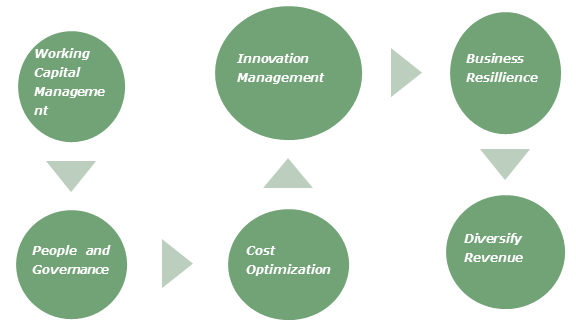
Challenging Times are also Opportunities to Improve Your Innovation Model Periods of disruption highlight existing challenges for companies. Management should safeguard the business while anticipating business trends, quickly addressing volatility and proactively establishing long term financial and operational resilience across the business.
Conclusion:

The above principles are also some of the tools which will help companies to understand macro points and coordinate the resources easily. But all the organization within the same industry will have to implement customized solutions. Management Consultants also cannot apply management principles to the industries without understanding its DNA, Cutlure and Objectives.

Management of Technology, Finance & Business is not required by true consultant or companies but Innovation on all of that aspects are required for better business resilience and survival. Adoptability to Invention by any organization will be the most critical factor in surviving them.
Share

Facebook
Twitter
LinkedIn

Subscribe

Are Business Opportunities for Real ?

Are Business Opportunities for Real ?

Are Business Opportunities for Real ?

Are Business Opportunities for Real ?

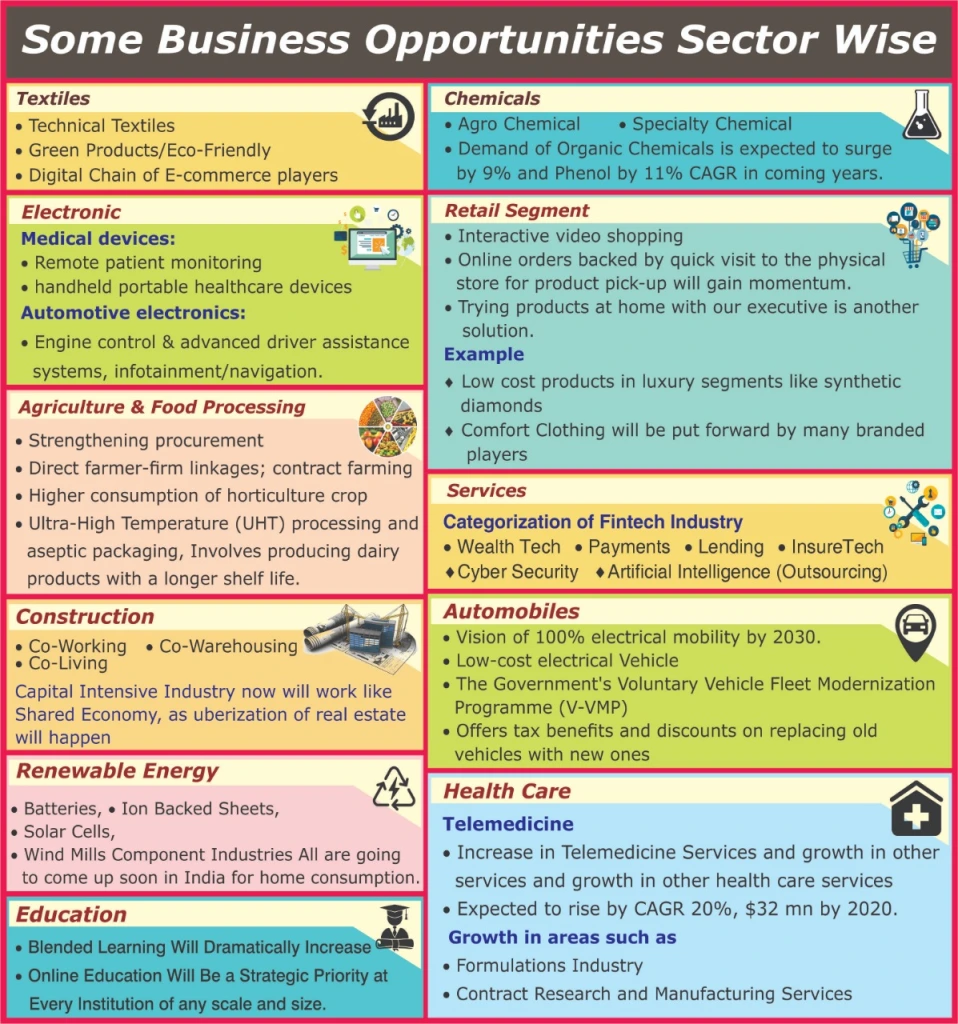
A key question that all existing entrepreneurs and traditional business face is finding the next business opportunity that is right for them. Should the Business Conglomerate or SME focus on introducing a new product or service based on an unmet need? Should the venture select an existing product or service from one market and offer it in another where it may not be available? Or should the firm bank on a tried and tested formula that has worked elsewhere, such as a franchise operation? Let‟s first understand what do we mean by “Business Opportunity” “Business opportunity what we are referring to here is “Long term opportunity which can be harnessed for Sustainable competitive business with long term Profits and capital appreciation satisfying the Needs of customers in the process” Opportunities can be Short Term, Mid Term or Long Term. However when the Business word is added before opportunity, we shall always have a very long term approach for it with wider spectrum of Vision. No generation has been able to build sustainable business by working on Short term business opportunities. Before going further to discuss about what are the Business Opportunities and ways of finding it we shall first idealize what are the pre-requisite of finding opportunities.

According to my opinion there are three important requirements of finding serious business opportunities.

 
  1. Existing SWOT: Find out Individual Competencies of Founder and Business Competencies which can match with future business opportunity.
  2. Invest in Feasibility Study: People don‟t invest in market research, consultant fees. Like when they used to buy land before 2014 they did not take proper reports with lawyers. Businessman need to take time and invest proper resources in the same.
  3. Industry Outlook: Have proper vision for the Industry and Sector u r entering into, it‟s like longer term commitment of your very much resources so u need to have proper vision for the same. Don‟t enter into any sector by looking at short term opportunities available.

4 Ways to find business opportunity

  1. Identify Sector & Industry: There are sunrise sector and sunset sector each has their own strength and weakness. Like telecom and power industry are already stressed in India but sometimes new demand is generated in disturbed sector Like Electric Vehicles in Automobile Sector. Sunrise sector has lot of competition as its weakness.
  2. Customer Research: Identify the target audience; Recognize the peculiarities of local customers‟ buying habits; Explore competitors‟ marketing research opportunities and strategies; Shape the product or service‟s identity; Understand what clients like most/least about the existing product; Define the true unique selling proposition;
  3. Network & Colloborate: Specific Industry Association is very much helpful for receiving proper technical & financial reports: Go out of your way to attend events and network. Become member of such associations to receive updates and knowledge of the market.
  4. Explore Market through Institutional Connects; After availing the Market Information, Create Customer Segments according to product range, geography etc,. Market size This is one of the most important criteria in all stages of product development, especially when you need to identify market opportunities. There are 5 all-round compass to Evaluate business opportunity which is altogether long topic I‟m just sharing some insights on the same: a. Industry Analysis b. Competition Analysis c. Risk Analysis d. Competitive Advantage e. Financial Risk Analysis e. Technological Analysis. We will go in depth some other time.

Conclusion:


The Fourth industrial revolution is on us. We no longer have to sort of ask as to when it will come, it’s here on us.” Our Country does have the talent and depth of technology to be able to do quite a bit. The wisdom of Indians should ensure that proper share comes to India. We have the people, the demographics, ability to skill our people very, very quickly. We have democracy; we have lot of things going for us But we as Nation have to make it count for us, instead of squabbling and wasting time; we really need to get our act together to be able to welcome whichever industry that wants to diversify its supply chains irrespective of Government Support as Entrepreneurs.

Share

Facebook
Twitter
LinkedIn

Subscribe

Move Over, Profitability Per Employee — There’s a Better KPI

Move Over, Profitability Per Employee — There’s a Better KPI

Move Over, Profitability Per Employee — There’s a Better KPI

Move Over, Profitability Per Employee — There’s a Better KPI

HRTech is bound to evolve in the coming times. Information Tech can be used to automate processes that are repetitive, prone to error and hypercritical. There are 50 per cent to 60 per cent of HR processes that can be replaced with process automation such as hiring and on-boarding, Recruitment, HR Administration, Analytics and Payroll processing.

For next decade, not just performance measurement or training or right recruitment process would be more than enough. Smart-Tech HR will need to be incorporated into designing of the organizational hierarchy functions and systems.

  • Continuous Performance Feedback Would Become a Key HR function
  • Personalized Learning Experiences Would Become Pivotal For Future Workforce
  • HR Data Analytics Will Be Key For Organizations To Drive Efficiency 

Using profitability per Employee to predict efficiency of organization is like using miles in India for measuring Distance. Under rare circumstances these two might be correlated, but often the relationship is trivial at best. Profitability Per Employee is seldom predictive of future growth or effeciency. Not all revenue is created equally, and not all employees are paid equally.

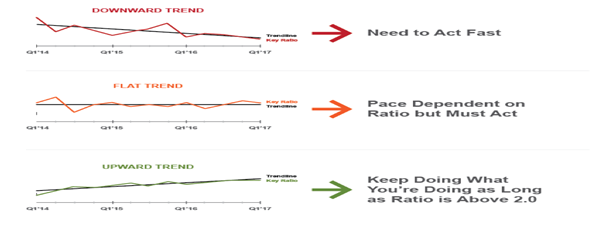
However, there is an alternative KPI which can more accurately help predict growth of the enterprise, what we call is Strategic Key Ratio. Here’s how it works:

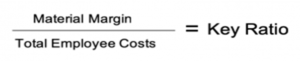
In the numerator, use material margin (or equivalent) rather than revenue. This is what a business has left over to convert materials into a product, and ultimately realize a profit. In other words, material margin represents the potential for value creation, whereas revenue as a numerator falsely assumes all our top line can flow through to the bottom line.
In the denominator, substitute the number of employees for total employee costs. Ultimately, the number of employees is unimportant. What it costs to enable those employees to do their jobs, however, is extremely important. Since we pay people more than just wages, total employee costs should include all people-related expenses: salary, commissions and bonuses, benefits, phone reimbursements, payroll processing, recruiting costs, professional development,.

This equation results in a telling snapshot of the state of a business. This ratio not only provides a snapshot of the financial health of a business, it also provides direction on where efforts should be directed to accelerate and sustain EBITDA growth:

  • Under 3.0: Focus on margin improvement, because what’s the point in driving top-line growth if you’re not keeping any of your hard-earned revenue? Remember, most businesses have no problem making money; they have a problem keeping the money they make.
  • 3 to 7: Pivot toward growth, but be selective about customer acquisition. Focus on targeted selling and catch a high-value whale rather than fishing for low-value minnows. Try and increase the efficiency of the employees by complete training, learning and development schedules.
  • 7 and Above: Congrats! Keep doing what you’re doing and consider strategic add-ons to further accelerate value creation.

Conclusion:

We all understand that there is a pivot to organization required in terms of Technology, Finance, HR, Business Model. But firstly & only, we all need to understand the current status of our organization resources & costs with right vision and data. We need to evaluate HR cost from eagle’s eye point of view and micro view both. Once we understand our data points correctly it will give the right directions for management action.

Share

Facebook
Twitter
LinkedIn

Subscribe