

Move Over, Profitability Per Employee — There’s a Better KPI

Move Over, Profitability Per Employee — There’s a Better KPI

Move Over, Profitability Per Employee — There’s a Better KPI

Move Over, Profitability Per Employee — There’s a Better KPI

HRTech is bound to evolve in the coming times. Information Tech can be used to automate processes that are repetitive, prone to error and hypercritical. There are 50 per cent to 60 per cent of HR processes that can be replaced with process automation such as hiring and on-boarding, Recruitment, HR Administration, Analytics and Payroll processing.

For next decade, not just performance measurement or training or right recruitment process would be more than enough. Smart-Tech HR will need to be incorporated into designing of the organizational hierarchy functions and systems.

  • Continuous Performance Feedback Would Become a Key HR function
  • Personalized Learning Experiences Would Become Pivotal For Future Workforce
  • HR Data Analytics Will Be Key For Organizations To Drive Efficiency 

Using profitability per Employee to predict efficiency of organization is like using miles in India for measuring Distance. Under rare circumstances these two might be correlated, but often the relationship is trivial at best. Profitability Per Employee is seldom predictive of future growth or effeciency. Not all revenue is created equally, and not all employees are paid equally.

However, there is an alternative KPI which can more accurately help predict growth of the enterprise, what we call is Strategic Key Ratio. Here’s how it works:
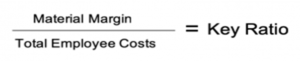
In the numerator, use material margin (or equivalent) rather than revenue. This is what a business has left over to convert materials into a product, and ultimately realize a profit. In other words, material margin represents the potential for value creation, whereas revenue as a numerator falsely assumes all our top line can flow through to the bottom line.

In the denominator, substitute the number of employees for total employee costs. Ultimately, the number of employees is unimportant. What it costs to enable those employees to do their jobs, however, is extremely important. Since we pay people more than just wages, total employee costs should include all people-related expenses: salary, commissions and bonuses, benefits, phone reimbursements, payroll processing, recruiting costs, professional development,.

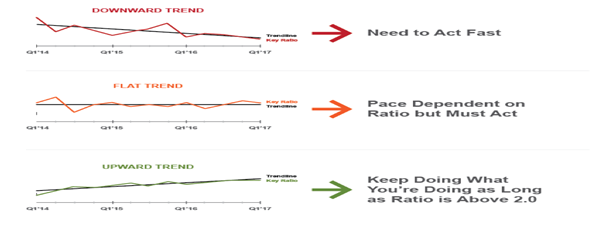
This equation results in a telling snapshot of the state of a business. This ratio not only provides a snapshot of the financial health of a business, it also provides direction on where efforts should be directed to accelerate and sustain EBITDA growth:

  • Under 3.0: Focus on margin improvement, because what’s the point in driving top-line growth if you’re not keeping any of your hard-earned revenue? Remember, most businesses have no problem making money; they have a problem keeping the money they make.
  • 3 to 7: Pivot toward growth, but be selective about customer acquisition. Focus on targeted selling and catch a high-value whale rather than fishing for low-value minnows. Try and increase the efficiency of the employees by complete training, learning and development schedules.
  • 7 and Above: Congrats! Keep doing what you’re doing and consider strategic add-ons to further accelerate value creation.
Conclusion:

We all understand that there is a pivot to organization required in terms of Technology, Finance, HR, Business Model. But firstly & only, we all need to understand the current status of our organization resources & costs with right vision and data. We need to evaluate HR cost from eagle’s eye point of view and micro view both. Once we understand our data points correctly it will give the right directions for management action.


Share

Facebook
Twitter
LinkedIn

Subscribe

How Much Debt Is Right for Your Company?

How Much Debt Is Right for Your Company?

How Much Debt Is Right for Your Company?

How Much Debt Is Right for Your Company?

Since after the FM’s financial stimulus package, Business man will have to undergo a complete transformation Financial Budget. Since the choice left with business man is either to increase the debt or infuse the equity for the operations. Now it’s time to tread this path more cautiously. Since the forecasting of sales will be inaccurate and more volatile. If a future sales forecast is slightly lower than the actual, this could lead to a huge discrepancy between actual and budgeted cash flow, which will have a significant effect on a firm’s future operating ability. The company has to take right infuse right amount of debt or equity for long term survival.

Companies will have to observe the balance sheet and profit and loss more accurately. No company will be able to take more pressure of increasing debt and yet at the same time face the risk of not able to restart their working operations effectively.

The question of how much is right debt becomes more pertinent and important. Companies will need to find the right capital structure mix to fulfill the strategic goals of the business and managing the working capital effectively.

Establishing sound debt & equity infusion plan policy:

During the course of business we sometimes forget the importance of financial planning and forget the distress it can cause to the future of business. Before going further we need to ascertain good, bad and worse scenarios of working capital and capital budgeting decision as per the required business growth of the company and ascertain financial requirements.

Below is proprietary tool of our company which is established. This is used by PDS Global Company CFO’s Ravi Jain, who heads the finance and treasury function of 600 US Million conglomerate a textile based company in HongKong.

The next 5 questions will determine the soundness of financial plan

  1. Find out current operations and cash conversion cycle of the company. Where do we stand as company in terms of financial reading of balance sheet?
  2. Can business model of the company be changed for managing the operations of the company?
  3. Assess the current debt capacity of the firms in current position & post debt capacity of the firm in good and bad situations of the firm so we don’t face any solvency issues
  4. Can the funds needed during the next five years be raised in a manner consistent with the target capital structure
  5. What is the company’s real financing requirements? How much additional money will it have to raise during the next three to five months and in next 1 to 2 years to carry out its portfolio of product-market strategies?

The easy accessible Debt at lower rate of interest ever than before will make entrepreneurs to plunge in vicious circle. They make it also to shrug off external factors and pressures. However debt always comes at cost i.e. repayment. So it’s advisable to consult, take proper advices & doing the financial planning more rigorously.

Conclusion:

The financial-planning teams will inevitably begin to establish a range of new capabilities within the finance function—for instance, rapid planning and forecasting; cross-functional collaborations; and dynamic dashboards, KPIs, and triggers. In the next normal, companies should consider ways to build on these capabilities and embed them into day-to-day forecasting and performance-management processes.

They may want to shift permanently to shorter financial planning cycles, more frequent review of KPIs, or the use of zero-based budgeting models. New dashboard in every function of business needs to be established and will become new normal to take effective decisions and faster.

Share

Facebook
Twitter
LinkedIn

Subscribe

Transforming for Growth: An Evidence-Based Guide​

Transforming for Growth: An Evidence-Based Guide

Transforming for Growth: An Evidence-Based Guide

Transforming for Growth: An Evidence-Based Guide

As the spread and far-reaching economic impacts of Covid-19 dominate the world news, we have all been witnessing and experiencing the parallel spread of worry, anxiety, and instability in business.

Indeed In a crisis, our mental state often seems only to exacerbate an already extremely challenging situation, becoming a major obstacle in itself.

Why is this? and how can we change it?


As the CEO of a firm, i’ll bring mindfulness to companies to unlock new ways of thinking and working. Is survival of Business this year enough or we have to navigate business for longer term with enough resilience? Most of the business will survive automatically this year as most of them have slashed costs but will they survive in near future? Long term planning has become absolutely unviable in this VUCA world. Moore’s law has become the norm not only for technology companies but for Traditional Businesses also.

Let’s see what’s happening in the real world out there.


First quarter of the year 2020-21 has ended with Nil Revenues for most of the companies. Companies have incurred production costs & expenses to start the momentum and business. Cash flows are not to be seen anywhere in near future. So what is that which may heal company’s losses to minimum this year or even break? What is required which shall turnaround companies structure in future.

Is it Economy Turnaround, Leadership Skills, Team Management, Innovation Management, Execution Capability, Technology Investment or Business Model? Which Tool Shall be used? When and How to implement the right strategies for this year for business?

Most ‘turnarounds’ are hype, so let’s be careful what we mean by that. Do you mean improving company effectiveness? Bringing back innovation to a group that has lost its creativity? Changing impact on the environment? Changing Business Model? Raised profits? Turning around an organization means more than improving the numbers. Everything needs fixing. Never again will the turnaround leader assume that customers always buy, vendors always ship, bankers always lend.

This is an unprecedented times where we cannot draw parallel example turnaround strategies. But what we can actually do today is learn and adopt from different successful growth transformation examples adopted in this adversity times.

FIVE WAYS TO INCREASE YOUR CHANCE OF SUCCESS


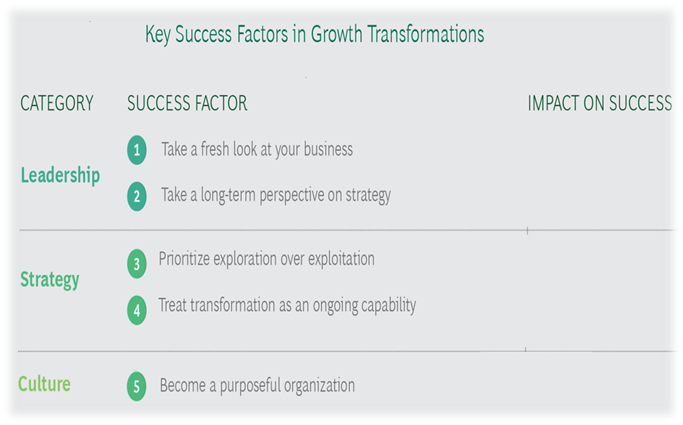
We believe that all the above functions may be necessary from time to time for any entrepreneur to survive. Given the long odds of success for growth transformations, it is important to understand what can be done to improve them. The Five factors that we identified as characterizing successful growth transformations in a measurable way span the categories of leadership, strategy, and culture.

Transforming for Growth: An Evidence-Based Guide

  • Leadership

CEOs play an important role in a transformation’s success. They can bridge business silos, allocate resources, and serve as role models for the necessary cultural changes. This is particularly important for growth transformations, which often can take companies into unfamiliar territory in the pursuit of new revenue opportunities.

1.  Take a fresh look at your business.


Incumbent CEOs who want to add an outsider’s perspective to their toolbox can break free of their traditional processes and mental models by using strategy games to explore a more expanded range of possibilities.

For example,  Satya Nadella, who was hired as Microsoft’s CEO in 2014, described himself as an “insider-outsider” because of his background in the company’s Cloud & Enterprise Division rather than the then-dominant Windows division. 

  • Strategy

Strategy is very much relevant in today VUCA world also, but it has be constantly reviewed and changed as per time to time. To create successful growth strategies, ideation capabilities bring together a rigorous analysis of consumers, customers, and trends within a proven framework.

Strategies need to be developed now for short term and long term goals both.

2. Take a long-term perspective on strategy. 


For example, in 2008 most major Indian computer game companies used a cyclical business model: they developed a game, sold it to customers for a one-time fee, and worked toward their next launch. Activision saw an opportunity to grow customer lifetime value by switching to a subscription model based around smaller monthly payments and more frequent, incremental, updates to games from their main franchises. SaaS Business based softwares have turned from one time installation fees to Subscription based fees per user per month.

3. Prioritize exploration over exploitation.


We found that growth transformations accompanied by high CAPEX & high R&D spend versus industry averages are 29 percentage points more likely to succeed. That suggests that a growth-oriented company should think beyond increasing sales of existing products and invest in developing new offerings, finding ways to continually reinvent themselves. Though exploration can seem riskier than exploitation, companies willing to explore can reap significant rewards.4.

4. Treat transformation as an ongoing capability.


Companies should lay the groundwork for future transformations by developing an adaptive firm with capabilities to change and respond quickly to new opportunities as they emerge—embracing an ““always-on”” approach to transformation. Firms also should build their knowledge base of successful change strategies, with the emerging science of organizational change.

  • Culture

Culture shapes companies’ abilities to respond to change by influencing how individual employees handle decisions. Cultures that instill a sense of purpose and think holistically about change increase the odds of a successful growth transformation.

5. Become a purposeful organization.


Our analysis suggests that companies that have a stronger sense of purpose are 17 percentage points more likely to transform for growth successfully. Asian Paints and Uniliver companies has become Business Institutions rather than successful entities with their goal of equitable growth to all stakeholders.

Conclusion


To lead a successful growth transformation, a leader must have a clear understanding of his/her values and priorities, as well as the motivation for taking on such a herculean task. Leaders need to communicate, communicate, and communicate more and more with all stakeholders for opinion, criticism and new ideas.

Survival = (speed of your understanding of the situation) x (the magnitude of the pivots/cuts/lifeboat choices you make) x (the speed of your time to make those changes)

Share

Facebook
Twitter
LinkedIn

Subscribe